
 by
by November 24, 2021
I. It’s been an interesting year. Whereas 2020 was quiet or rough (or both) all the way around for people, 2021 has been about everyone coming back online, but at their own pace and in their own time.
My year was divided into halves. I spent the first with my sons, who were still at home as they went through their final year of high school on their computer screens. Both adapted quite well; grades-wise and in varsity basketball. Although I’m grateful to have maximized the time with them, everything felt very much like Groundhog Day.
Spent the earliest weeks writing and producing the book. I was able to go from conception to published, physical book and Kindle in less than eight weeks. That blows my mind … and it’s great to be able to tell customers that “Yes, I can take your project idea from concept to book and publish it on Amazon. Here’s the proof.”
When summer hit, I committed to a co-working facility, Galvanize. And that definitely did the trick in terms of changing from “I’m home forever” mode to sharper focus.
The experience made me wonder what the future employee’s “headspace” is going to be like. Companies must embrace remote work. What does this portend? Well, never again will an employer have 100% mindshare of its people. When you’re working from home, the focus is not the same as at the office. Facetime, and no I am not talking about the Apple product, is going to take on much higher importance. As will brevity.
II. Quick aside. Novel environs always help, yet in ’21 I was unable still to take advantage of the coffeehouse tactic I’d used for years.
When the kids were in elementary school, I was content to work from home all day by myself. Any time the silence felt a bit oppressive, I ventured up the street to The Coffee Bean with a laptop and certain tasks I reserved for that venue. Oftentimes, before I even entered, the crew seeing me coming would begin preparing the Americano I always ordered. A small act, but an affirmation of the welcome and routine there that I didn’t realize how much I enjoyed until it was over.
Sometimes I’d visit with other regulars—people I only knew by first names and with whom I only interacted at the Bean. Regulars like Diana from New Orleans, whose husband Jordan would often accompany her until he lost his battle with cancer in 2016. Or Steve, a fascinating typical Austinite — brilliant and probably a PhD, and someone who waited tables in one gig and worked third shift in another.
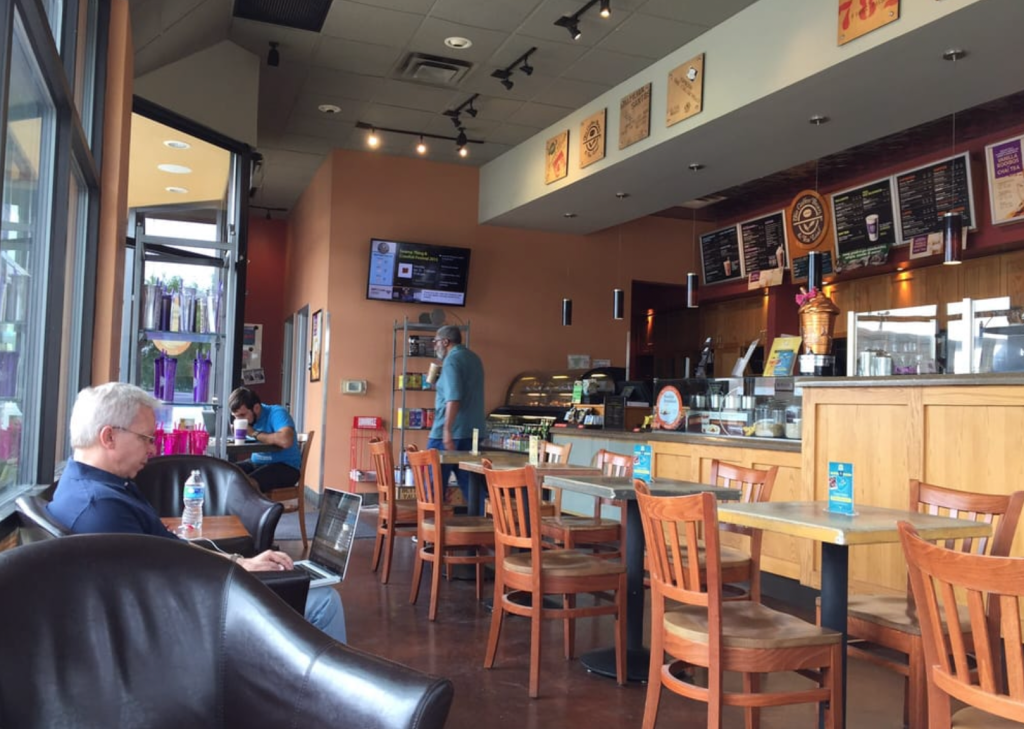
Over an eight-year period I’d written and edited hundreds of thousands of words in the Bean. Whatever I’d been working on — whether corpcomms or off-topic things such as emails to parents in a youth basketball league I helped organize — I found the white noise of the place stimulating (and of course I listened to a ton of music on earbuds there while plugging away). On occasion I’d even do networking meetings there.
The familiarity gave me just the right, subtle sense of connection. The Bean was my second office until COVID-19, when the place closed its doors and never returned. There are certainly other coffee joints, but this was the one for me.
III. Now in the second half of the year, I am reunited with a former client helping with all things message-oriented. It’s going well. I’m grateful and motivated to help an organization that I’ve incrementally worked with for the past 11 years.
[In the post-COVID working moment it is interesting to see this organization’s effort to maintain the culture which was instrumental in making it a success. Its corporate headquarters involved the dramatic transformation of an abandoned shopping mall. Today the physical symbol of this company is still at ~75% below-capacity.]
There was also downtime for me in the first half of ’21, but this should not be confused with leisure or paid free time. I’d describe it as long days with a persistent tension. There’s a constant sense of responsibility to check in, to stay busy, and to never drop away and become unavailable because you have chosen to take the rest of the day off.
IV. The 2020 “Fallout” changed us forever. The way people interact from here, especially the workplace itself, will never be the same again.
While that plays well into what I do for a living (writing can be done any time, any place, as long as you have a device and a connection), I’m currently working hard to optimize the fact we’ve adopted the Zoom call as the default. I bought better lighting, and I’m proactively setting up and on calls that supplant the “coffee meetings” of 2019, a world that is now dead.
Videoconferencing generally means shorter exchanges and that you can work for anyone, from anywhere. (And no commute.) But it also kills energy, is laden with inefficiencies and often turns participants into passive, distracted blobs.
Regarding physical offices, I’m excited to see what that means for commercial real estate and corporate builds. You’ve got Microsoft’s $5 billion commitment to a major overhaul of its 500-acre campus in Redmond, Washington, that will add 17 new buildings, 6.7 million square feet of revamped work space, trails and sports fields in four “villages.” (The transformation, which includes outdoor work spaces and treehouses, will enable Microsoft to add 8,000 more employees.)
Right now from my porch ten cranes are visible in the Austin downtown area. On the other end of the spectrum, expect many companies to choose no HQ. They’ll look instead at a network of smaller check-in “locations” all over (Transient presence in co-work spaces, some of which I saw over the summer, and which mainly rely on teleconferenceing, software, and tools.)
The purpose of the workplace is going to change. Obviously, the ability to work from home will remain a priority. But given that nothing can replace the unique advantages of being at a physical office, others will see a return to a dynamic that no Zoom call could ever duplicate. Future organizations, even small ones, will design themselves to accommodate both experiences, as seamlessly as they can – via technology and connection.
 Stuart Wade