
 by
by The news media is the problem.
The Washington Post declared last week that newsrooms can build trust by moving beyond objectivity.
Being less objective will make the news more trustworthy? What a terrible idea.
It is clear that traditional media outlets are struggling to maintain the non-partisan, objective stance that was once the key to their success.
Social media has taken us back to the early days of this country when the press was aggressively partisan. Back to a time where political parties sponsored newspapers.
The difference today: In the smartphone-and-twitter era, “Big Journalism” news media have lost their relevance and are no longer as powerful.
They know this, and it disturbs them.
A friend of mine in the business likes to say: “There are two ways to react when you are beaten on a story — ignore it or piss on it.”
Today, I would argue a third reaction: expunge via algorithm.
Audiences have been steadily declining due to censorship, polarization, and the “journalism by omission” push to erase opposing views. More on this below.
The Big-J, Blue Check journos’ loss of credibility and inability to provide objective journalism is a direct consequence of their recent behavior.
News media, wrote one observer, is a click-seeking machine dressed as a truth-seeking machine.
“Objective” journalism is a relatively new thing. It was born out of need — if you were impartial in your coverage and reporting, you could sell your product to the widest possible audience.
The idea of objective journalism was a business strategy that made companies more money – when media were advertising-supported, its stories and content could be only moderately “leaning.” Newspaper executives worried about upsetting advertisers.
Today, with fewer/no advertisers, major print outlets worry about upsetting subscribers. Where an ad model relies on a mass audience, a subscription model relies on a niche audience.
Thus The New York Times (and its competitor in DC) becomes just another media source with an agenda. As a result there is no more truth, just competing narratives.
Can’t say this enough: The news media is the problem.
The end of trust in media. As media outlets become increasingly isolated, purposely polarizing, it becomes harder to have meaningful and constructive conversations about important topics.
We will see more media “islands,” delivering their own versions of reality to (smaller) subscriber bases.
Different versions of “the truth” make it difficult to have civil debates, resulting in an atmosphere of intense polarization where even long-time friends can find themselves arguing heatedly.
[It’s tribalization to the point where you can’t have a friendly pint of beer with a neighbor of 20-plus years without being shouted at, simply because you have an opinion that differs… and you can back it up. Enduring this unpleasantness is a recent phenomenon; for the first 25 years I lived in this city, I never once encountered it.]
There is an all-out effort underway to erase opposing views. This became crystal clear in 2020, when the kids in the NYT newsroom succeeded in getting their more veteran, op-ed leaders ousted. (It’s their fucking OP-ED PAGE.)
Today the game is: smear or ignore the thing being disagreed with. You wouldn’t believe the willingness of Yale and Harvard experts, so-called, to smear their colleagues, their fellow ‘experts’ and scientists with contrary opinions (much, too, has been made of the death of ‘expertise,’ which is a whole ‘nother topic.)
The FOIA game is a similar problem: Lazy reporter files Freedom of Information Act requests – plural – issuing one after another; meanwhile, their target(s), required by law to release the information, slow-walk the process.
Meanwhile, Harvard and Yale: private institutions. Conveniently their experts are not FOIA-able. Google: “The Federal FOIA only applies to ‘agencies’ of the Federal government, which term includes the U.S. Department of Education (DOE) but not universities that are organized under State law.”
From there, the Big-J journalist sifts through received documents, in a fishing expedition until he or she identifies emailed, ‘private’ conversations that best support the narrative. Gotcha!
According to Pew, trust in media is not just at an all-time low — it’s not even come close to this record-low number before. [ADDING: And Gallup.]
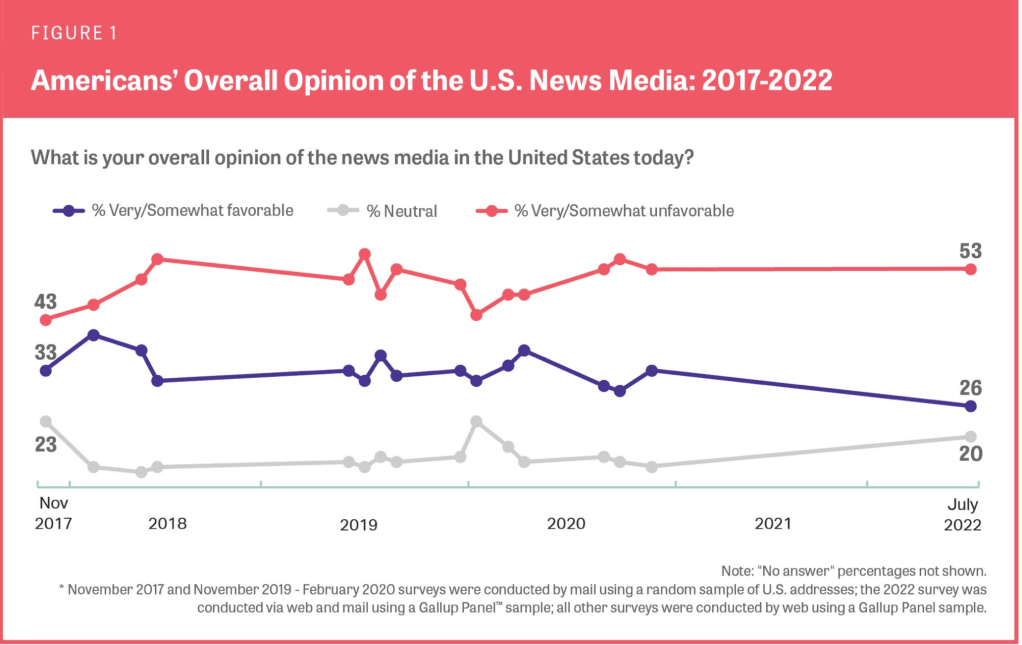
Untold numbers who once assumed that you could depend on the Times or WaPo to give it to you straight, have stopped believing that. And probably will never again. (Fox and CNNMSNBC are two sides of the same coin.)
What can be done to increase trust in media?
Fight back, in the press. Non-elites must take steps to get their own narratives into the media, just like the Big-J elites have been doing successfully for decades.
Create environments that are open to different perspectives. Expect more moguls (of every stripe) to buy or create more major media. From Hearst to Elon, the history of the United States is filled with such examples.
We need more information, not less. When everyone in a newsroom thinks the same there is no imbalance to rationalize. (The answer is not, “newsroom completely surrenders to the child mob, triggered by contrary opinion” and/or “block and Unfriend.”)
Until this happens, the non-elite will continue to be censored out of public consciousness and persuaded, rather than informed, by brand-name media.
If it ever wants to see those trust numbers get off the mat, Big Journalism must embrace a new approach that recognizes and includes different perspectives. The last thing it ought to do is “move beyond objectivity.”
 Stuart Wade