
 by
by November 19, 2021
Eugene Phillipp was an iconic teacher at Reitz Memorial High School. He provided a unique outlook on the world
“We pray before class every day, except for test day, as I don’t want my students to gain an unfair advantage” — Brother Eugene Phillipp, csc (1938-2009)
Each of us remembers that one teacher who stood out. At Reitz Memorial High School, Brother Eugene Phillipp was one of a kind, and easily the best teacher I ever had.
From 1962 until his death in 2009, Eugene taught U.S. history, world history and psychology (juniors and seniors only) ran the school bookstore with self-appointed “German efficiency,” and took in just a handful of annual helpers/understudies (juniors and seniors only, more on this below) to help with the store and other MHS operational duties he routinely oversaw.
Along with thousands of other Memorial students over the years in his classes, I learned a great deal about a great deal from Eugene. A repository of stories, trivia and knowledge with the greater ability to impart it, Eugene was an ardent traditionalist with an incredibly sharp wit.
A native of Cleveland who attended Notre Dame, he prepared his charges for life beyond his classroom. Eugene’s history and psychology lectures were college-level. He understood college prep and was the only instructor at MHS who organized his courses accordingly. His classes had a syllabus and each session was an actual lecture during which he paced the room wielding a pointer and speaking from memory. Brother was often anecdotal and always ON, with vivid narration of American history. You took notes and didn’t ask questions until prompted during the final minutes. There was no textbook. (“I don’t use a textbook because life does not have a user’s manual,” he’d say.)
He led optional historic ‘simulations,’ usually conducted on a weeknight, just once or twice per semester. In an extra-credit simulation, you’d drive over to the school, join the other 40 or so classmates who decided to come, and then divvy up into teams… And then there’d be a ‘world crisis’ you’d have to solve. There would be team diplomacy and double-crosses resulting in the annexation of the Sudetenland, or Wall Street crashing, or the US bombing some fictional aggressor back to the Stone Age, etc.
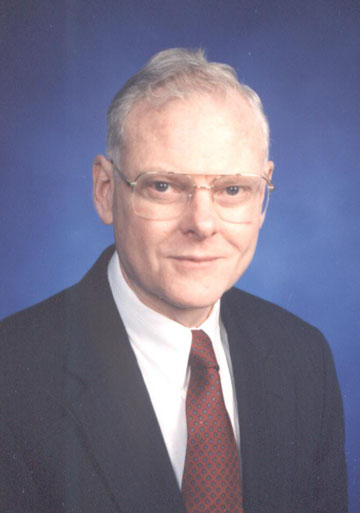
Here is the link to Eugene’s obituary.
He gave pop quiz questions that were seldom, if ever, difficult (many were open-notes) designed to ascertain whether you’d paid attention in lecture. Brother was adept at “busting” the various gum-popping distracted athletes, future homemakers, or dissaffected army-coats and other idlers who hadn’t been keeping up, via this extremely effective tactic.
Those who were unwise enough to disrupt Eugene’s classes never got detention. They were sent instead to sit outside his door during his class, a kind of hallway shaming that served as a far worse fate than mere detention. You might be in a different class period on your way to the bathroom and you would on occasion see a person slumped in front of Brother’s closed classroom door and say to yourself, “Somebody was passing notes in Eugene’s today.”
• He taught upperclassmen only. This was learned and by choice, he’d kid. He “loathed” freshmen (made a show of rolling his eyes, for your enjoyment), but actually scouted sophomore academic talent, and would suddenly appear in your life late during your soph year and know your name and a few things about you.
• You could “Challenge” the veracity of anything Eugene mentioned in any given lecture. He would then have 24 hours to provide the source material (I wonder if this time-period tightened at all in the Internet era). You then either owed him a quarter (finder’s fee) or, he owed you the quarter – not because the item was not factual, mind you, but only because he couldn’t locate the source. He would only “lose” a Challenge about once per school year only, which was always big news. To this day, I vividly recall the lone Challenge I made, and of course, lost: During the Gold Rush of 1849, some miners got so rich, that they had their laundry shipped to China to be washed and brought back to the U.S.
• Incredible dry wit. In world history he lectured that Catherine The Great had a penchant for horses, and was killed by a massive stroke. Pause for effect, slight eyebrow raise and visual sweep of the room — then he’d move on.
• His own brand of jargon:
– Hitler (e.g.) was a Loser. [Spoken with disgust]
– To indicate the end of lecture near the close of class he’d say, “Alright. Do the housekeeping,” and that meant you could put away your stuff.
– …And of course he picked up on my close friends’ nickname for me and forever more also called me, “Stuey.”
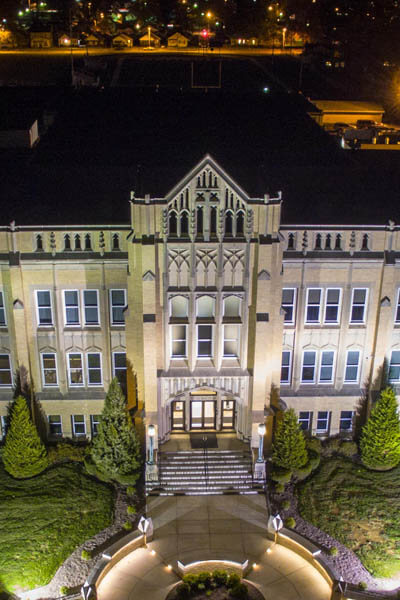
– Still in use in Evansville, the MHS building dates to the 1920s, and if during winter months during lecture he saw that the radiator heat was lulling kids to sleep, he’d throw open all the windows and say “It’s time for The Freeze-out.” The Freeze-out had a 100 percent success rate, even though each actual ‘chilldown’ only lasted for a few minutes.
When your class was consistently inattentive or acting up, and the poor behavior extended over a few meetings without calming down to Eugene’s satisfaction, you would get the dreaded Monotone. He would simply deliver the same lecture in a flat lifeless single “note.” For 45 minutes.
I graduated in 1982 and when I was a student, Eugene still led “tunnel tours” of the original section of the school including a sub-basement, tunnels, air shafts and finally, the rooftop. The tradition began in the 1970s (not sure how long it endured), and he charged a dollar, which went in the bookstore account.
Classic Eugene phrases (and a handy translation):
Elucidate! (Please elaborate!)
You see…or don’t you see? (Does that make sense?)
Here’s an Aside. (What I’m about to tell you won’t be on the test)
Tough Number (A real man – “TR was a Tough Number”)
A few more of my favorites from his class:
On the first day of school, he’d announce, “Normally we start class with a prayer, but we will refrain this week so that all of the atheists, agnostics and pagans will feel at home.”
“People were traveling West in droves. Well, some took buses.”
“Oh, those Federalists. What a sense of humor. They nominated C.C. Pinckney.”
Just prior to tests, I can still see and hear (flip, flip, flip, flip) “Last row, please.” (Flip, flip, flip,..) “Second last row, please.” ( ) “Center row, please.” … “Your row, please.” … “And your row.” …as he passed them out.
I got the news in August 2009 from several sources that Eugene had passed away.
Eugene Phillipp was a warm, incredibly smart person and a gifted teacher. I think about things he taught us on a weekly (if not daily!) basis.
Thanks to Ron Kremer and Greg Wannemuehler
ADDING 3/1/2023
Someone pointed me to the “Eugene edition” of the Memorial fundraising periodical, Memories. Within are numerous remembrances and I wanted to single out a terrific story (which I’m going to paraphrase here):
Eugene was also the school’s defacto COO. When the cafeteria chairs had reached the clear end of their usefulness in 1985, he ordered a couple hundred replacements — and hired a man to assemble all of them after school the same day they arrived, replacing the original/worn chairs for the next morning.
The assembly of each was straightforward; a new chair consisted of a molded plastic top mounted atop a tubular steel base. The next morning when the students in US History entered Eugene’s classroom, one of the assembled chairs was perched, on display, atop Brother’s desk at front.
Evidently, there were two possible ways to assemble the chairs: the first way placed the user in an uncomfortable position, having to lean back and brace his or her feet on the floor so as not to slide off.
The second way was the correct configuration.
All of the chairs had been assembled using the first approach. Brother calmly began the hour with the customary quick prayer for that class. However, instead of a history lesson that morning, Eugene took the opportunity to use the chair assembly to deliver an impromptu lecture. Its theme: “The merits and advantages of making smart decisions in life.”
 Stuart Wade