
 by
by On being an Indiana Hoosiers football fan, Part 1
College football summons the emotions of millions. Generations of us watch. We revere the excellence of the traditional powers, we honor the athleticism of the players and we follow the winners closely in a weekly win-or-lose saga as the season builds to a dramatic conclusion.
But what about the perennial losers — teams and programs that have spent years in the wilderness? Like the Georgias, Alabamas and Texases, the losing programs, too, have devoted fans who assemble, and who hope. So when success finally does arrive for them, it’s kinda glorious: Kansas. Duke. Kentucky. All stunk for years, all got their act together recently.
And the Indiana Hoosiers. My team.
I have watched a lot of bad college football. A lot.
For decades.
When you do this, when you experience this sort of delusional PTSD — as a defense mechanism, you play mind games with yourself.
You bargain:
• If we can just get this first down… Or this stop…
• Maybe, if we hang in there and keep it close…
• “That’s okay, we weren’t supposed to beat this team.”
And on. And on. For those of us who’ve walked this long road with Indiana football – in my case, for over five decades – it’s been a meandering path of false hope and breakdowns.
But finally, improbably, it’s worth the wait.
Throughout college football history, “Indiana football” and “woeful” have been practically synonymous. No team in Division 1 (yeah I said D1 not “FBS,” whatever that means) has lost more games than IU.
Before this Fall, IU football history offers precisely two shining moments: a 1945 Big Ten champion that went 9-0-1, and 1967 when we went 9-1, tied for first in the conference and reached the Rose Bowl, only because we won the tiebreaker by having the longer Rose Bowl drought. And we lost, 14-3, to OJ Simpson’s USC team.
(Sidenote: a few years ago, I finally tossed out my 1968 Rose Bowl sweatshirt, which had been reduced to a crumbling piece of fabric at the bottom of a drawer. Now I wish I’d kept it. Yeah, I think my grandparents bought a sweatshirt for each person in my family that Christmas – so of course I was very small and don’t remember at all – but the sweatshirt endured for many years)
My connection to Bloomington and Indiana University began with childhood football weekends. We’d drive up from Evansville for 1 p.m. kickoffs, and while I loved the pageantry — the marching bands, the stadium atmosphere — what strikes me most was watching my parents’ elation with being back at the site of their glory days on the campus where they met, in the town where, newly wed, they resided as my father attended law school. (It’s a feeling I can relate to now, with son John currently a senior there.)
The Corso era
The 1970s brought head coach Lee Corso from Louisville — a showman who understood television and brought some flair to the program. Corso, who had played alongside Burt Reynolds at Florida State, used his outsized personality to boost recruiting.
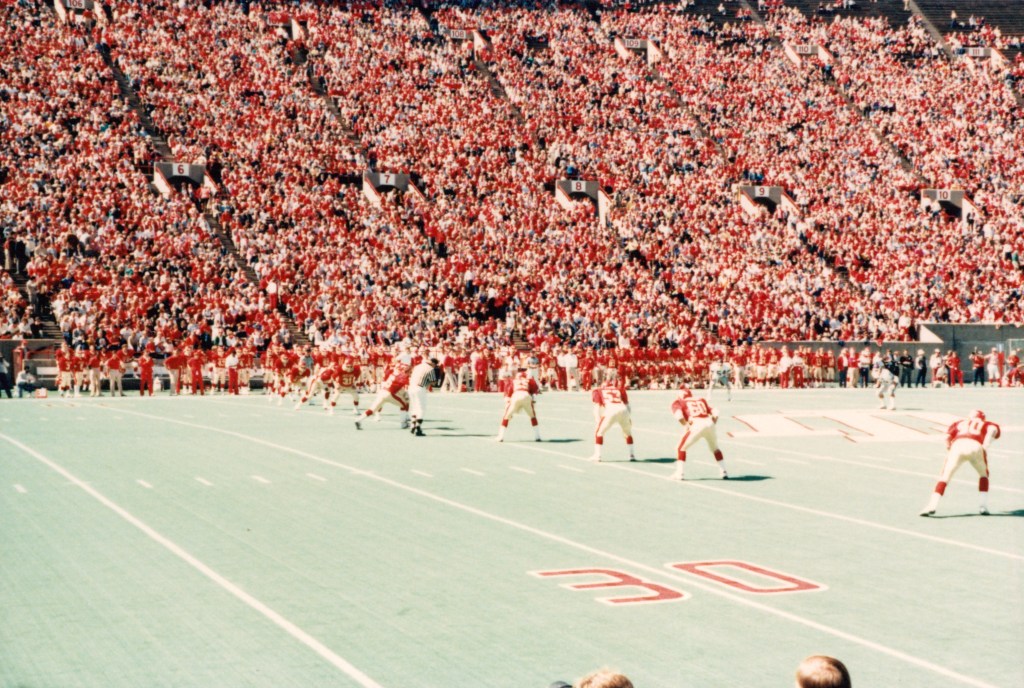
My siblings entered IU during the Corso years—my brother James “Woody” Wade until ’78, my sister Cynthia til 1982—coinciding with the basketball program’s incredible run under Bob Knight. I followed right after Cyn left IU, continuing a tradition of infinite pigskin patience and football fan commiseration with my IU FIJI buddies that continues to this day.
Corso’s decade proved turbulent but memorable. He convinced ABC to broadcast its national “Game of the Week” from Memorial Stadium—which we promptly lost to Nebraska 69-17 in a downpour. My entire family was soaked. (Payback this past October was pretty sweet: IU 56, Nebraska 7).
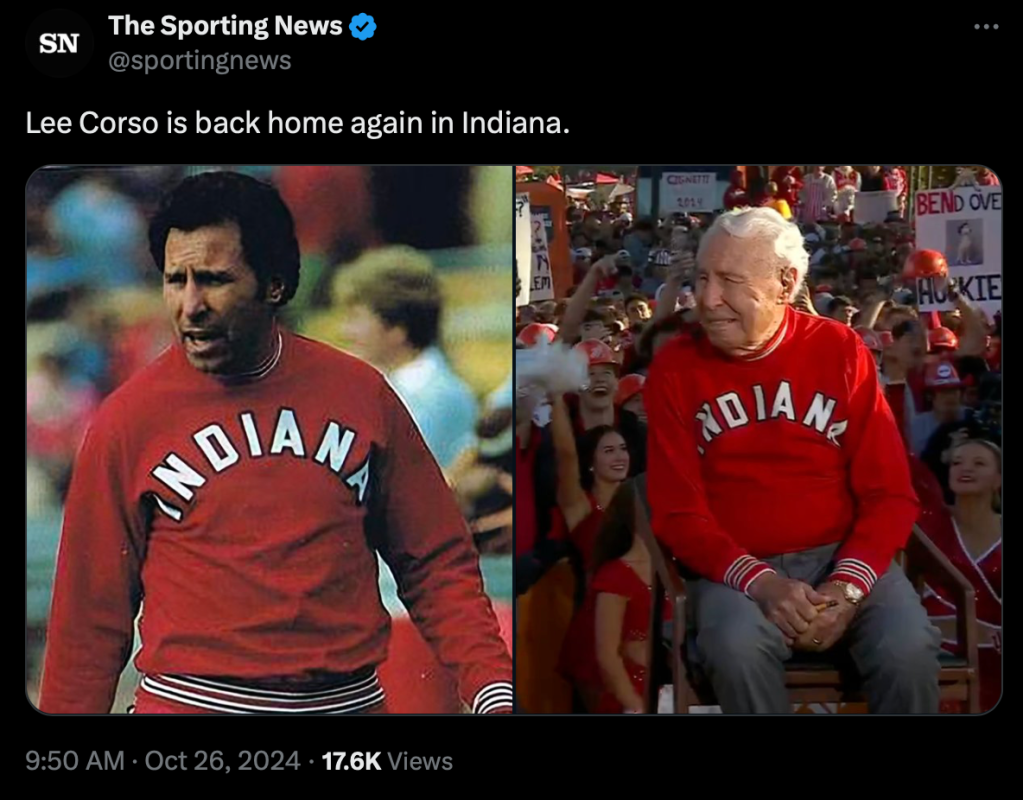
But in 1979, we claimed our first bowl victory in typical Indiana fashion: Brigham Young missed a chip-shot field goal at the gun, giving us a 38-37 Holiday Bowl win. That eight-win season could have been even better if not for a notorious phantom pass interference call that handed Michigan a victory in Ann Arbor—a loss that still stings old-guy Indiana fans.
Coaching carousel
Success in college athletics almost always hinges on hiring the right head coach. After Corso, Indiana’s choices read like a cautionary tale. Sam Wyche arrived at age 37 in 1983, only to depart after a single season for the Cincinnati Bengals’ top job.
But then came Bill Mallory, who transformed a winless 1984 team (my junior year) into a power-running juggernaut. The Mallory era brought genuine success. After nearly three decades of futility, we finally beat Michigan in 1986, and then shocked the Ohio State Buckeyes.
Following the Buckeyes’ 1987 loss to us, 31-10, Ohio State coach Earle Bruce dubbed it, “the darkest day in Ohio State football history”—a ridiculous notion that IU fans instantly converted to t-shirts proudly displayed that fall. (The last time Indiana’s beaten OSU was 1988; IU last defeated Michigan in 2020.) Mallory earned significant success over his 13-year tenure, leading the Hoosiers to six bowl games and earning back-to-back Big Ten Coach of the Year honors in 1986-87.
Finding (and losing) leaders
Mallory’s crowning achievement was an eight-win season capped by a 1988 Liberty Bowl win over South Carolina and the development of Anthony Thompson, a powerful running back who should have won the 1989 Heisman Trophy (he finished second to Andre Ware). The Mallory era peaked with a dominant 24-0 bowl victory in 1991 over heavily-favored Baylor.
At 69-77-3 Bill Mallory is IU’s ‘winningest’ coach.
Let that sink in a bit… 8 games under, and IU’s been playing football for 136 seasons.
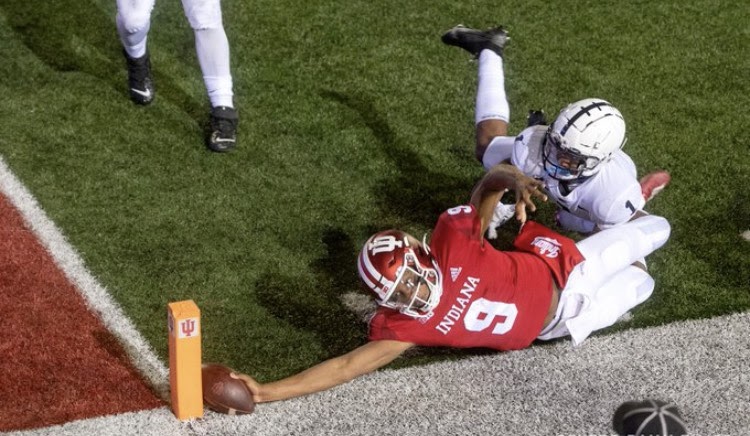
Indiana’s history shows it can occasionally land exceptional talent. Beyond Thompson, the program discovered Antwaan Randle El, the electrifying quarterback from suburban Chicago in the late 1990s who threw the game-winning TD pass for Pittsburgh in Super Bowl XL. (Randle El and NC State QB Philip Rivers put on a show at a 2001 IU home game I attended, a 41-38 shootout in which the last team with the ball, the Wolfpack, prevailed.)
More recently, Michael Penix Jr. emerged as a generational talent—only to transfer to Washington for his final year, leading the Huskies to the national championship game. It’s a bitter irony: the quarterback whom IU couldn’t protect well enough to keep him on the field and healthy finally found championship-level success when elsewhere and surrounded by solid supporting cast.
Post-Mallory, our coaching searches read like a comedy of errors: Cam Cameron, an NFL coordinator and IU alum (18 wins and 37 losses); Gerry DiNardo, a former SEC head coach (8-27) who proved arrogant; Terry Hoeppner, a bright spot taken too soon by cancer (9-14); his assistant Bill Lynch (19-30); Kevin Wilson, an offensive savant deemed too difficult to work with by other Power 5 programs who might’ve otherwise hired him (26-47); and finally, Tom Allen (33-49), a former high school coaching success turned SEC coordinator who wore his heart on his sleeve.
Allen’s tenure deserves mention. His emotional style either inspired or embarrassed, depending on your perspective, but with Penix at quarterback, IU delivered some big moments. The 2019 season brought eight wins, followed by the COVID-shortened 2020 campaign where IU went 6-1 in Big Ten play and finished 12th nationally. The fan base dared to hope. Then came the crash: a 2-10 season, and more mediocrity that Allen never recovered from.
Which brings us to 2024, where suddenly, improbably, Indiana football is good — Really, really good.
[To be continued…]
 Stuart Wade
3 Comments