
 by
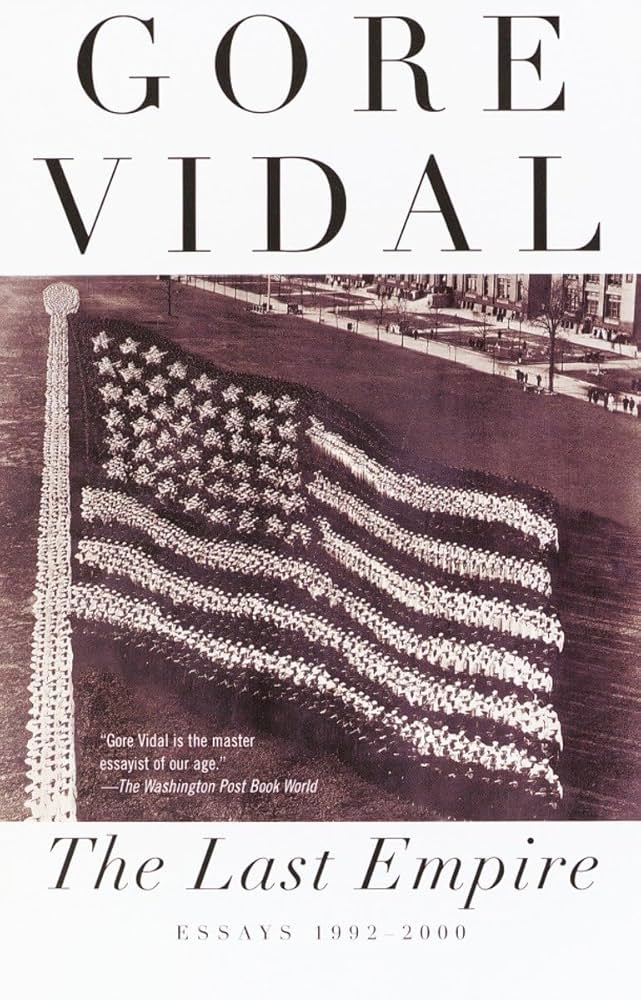
by Book review: The Last Empire: Essays 1992-2000 by Gore Vidal
Earlier this month I mocked ‘the book review.’ Why not? — I became a reviewer quite by happenstance and enjoyed it. Still, there’s no school for Criticism. Sure, you can find degree programs tucked away at UPenn, Georgetown, even Purdue — but c’mon! You think the Evansville Courier is hiring UPenn criticism grads and paying them $50 a throw? I don’t think so. The real reviewer education happens down in the trenches, brother. Anyway, here’s one I wrote for The Westchester News Journal—Paul liked it enough to borrow my review copy.
Admired by liberals, despised by conservatives and misunderstood by both as disloyal to his country, Gore Vidal shouts what most of us are loath to speak above a whisper.
Much has been written about the legendary novelist, playwright and onetime political candidate who seems to know or be related to every important figure of 20th century America.
Vidal struts his razor-sharp stuff in The Last Empire: Essays 1992-2000 (Doubleday), a collection of articles that first appeared in such publications as The Nation, The New York Review of Books, GQ and The Guardian.
Written during the media-saturated Clinton era, a period which blurred the lines between political celebrity and the classical morality play, the collection reveals one of America’s finest writers in top form. In nearly 50 entries guaranteed to delight as well as offend, The Last Empire examines familiar Vidal themes of American celebrity and politics.
Few would know more about this territory than the author, who enjoys a privileged perspective.
As Insider/Outsider, he has observed political machinations from a strategic position. A stepbrother to Jacqueline Bouvier and distant cousin to Al Gore, he grew up in Washington in the home of his grandfather, Thomas Gore, a Democratic senator.
As one might expect of a political son, Vidal at one point aspired to public office. In 1960, he ran unsuccessfully for Congress in New York, and in 1982 he was runner-up in a California senatorial race.
As a political writer, Vidal’s opinions have come to be viewed as dangerous, brilliant, or both. Because he writes with the zeal of a politician who faces no political consequences, his commentaries are riveting, often reading like stump speeches.
One must bear in mind that this literary lion, a self-appointed soothsayer, is ultimately a self-promoter. He belongs to a generation of literary celebrities — Capote, Mailer, Wolfe — who shone as brightly as the stars they covered, though his prophetic pronouncements often served his own legend.
In a pre-2000 election essay entitled “Honorable Albert A. Gore, Junior,” he writes, “I too wanted to complete the family business. But after three years in the Army in the Second World War I had become a novelist. I had also been infuriated by American attitudes to same sexuality and so, between a new political career already mapped out and publishing a book that would the more effective it was end all hope of entering the family business I chose virtue and published The City and The Pillar… When Albert… was born shortly thereafter, the clan was back on track. There has been a weird symmetry to all this whose meaning I leave to the witches on the heath.”
It’s notable that one need not agree with the author’s politics to enjoy The Last Empire. Vidal dazzles most brilliantly in the new book when he mixes historical and literary criticism with informed gossip about such luminaries as John F. Kennedy, Clare Booth Luce and Charles Lindbergh.
One of Vidal’s advantages is his ability to credibly contribute personal insight into literary critique. In his review of a collection of letters exchanged between Franklin Delano Roosevelt and Daisy Beekman, Vidal writes, “I never detected the slightest affection… for Franklin in the talks I had with Mrs. Roosevelt during the least years of her life.”
Vidal, who knew both Beekman and Eleanor Roosevelt, goes on to proclaim that the letters “leave no doubt that FDR and Daisy were in love.”
Similarly, in a review of Seymour Hersh’s controversial The Dark Side of Camelot, Vidal’s inside information makes the reader privy to the sort of conversations one covets but rarely experiences firsthand:
“Jackie knew all about Jack’s sex life in the White House and before. What she did not want was any sort of confrontation with his playmates.”
While Vidal gives readers a seat at the table, his reviews can be punishing as well. In a 1996 dismantling of John Updike (in which the skewering of the latest Updike novel is clearly an afterthought), Vidal rips Updike’s conservatism, conjuring past feuds he’s fought with Norman Mailer and William F. Buckley.
As a political essayist and cultural critic, Vidal – who has split his residence between the United States and Italy for several decades – is known for his outspoken and often outrageous criticism of government and the corporate/political machinery.
Just last month, Vidal attended the execution of Timothy McVeigh at the condemned man’s request.
In “Shredding the Bill of Rights,” Vidal condemns the government’s role in the Branch Davidian fiasco. Citing the deliberate erasure of The Bill of Rights in Waco, Vidal recognizes the horror that Timothy McVeigh later wrought on Oklahoma City, but loses perspective between movements and individuals when he offhandedly explains that McVeigh “suffered from an exaggerated sense of justice.”
In his retrospective analysis of Waco and Oklahoma City, Vidal casts David Koresh as a mildly crazed religious leader ripe for FBI/ATF persecution. He also excoriates Attorney General Janet Reno for having presided over “the largest massacre of Americans since… Wounded Knee.”
Because Vidal believes America is an imperial, national security state, run by a small group of powerful corporate interests “without whose money and media no one can be elected president,” he frequently comes across sounding like an Oliver Stone character:
“[The corporate ownership] may fear and loathe [the candidates] but they always hedge their bets and always pay for both candidates. Later, at the dark of the moon, they collect their ton of flesh from the winner.”
For Vidal, this no-lose situation is a grim harbinger for American politics.
However, he stops short of claiming that the American corporate cabal amounts to a conspiracy; rather, that the various, faceless corporate goons share similar goals and nearly identical tactics.
It’s maddeningly convenient for the author to believe that “the media are in place to give us Opinion that has been manufactured in boardrooms.” But it’s a fascinating hypothesis as well, because it gives Vidal broad sway to provoke as well as entertain.
Vidal also plays the role of the structural revolutionary in his analysis of the current political system.
In Last Empire, he writes that the Supreme Court is now no more than a de facto legal counsel to the President, its principal function making executive decrees.
And in a transcribed speech he declares it is time for Americans to deploy Article Five of the Constitution (the power to call a Congressional convention) and reinvent the government before further damage occurs.
Love him or hate him, there will never be as unique a gadfly as Gore Vidal. Over a long and impressive career, he has produced a fine body of historical fiction, plays and non-fiction writing on politics and literature.
This homegrown aristocrat can be viewed as either a bitter, irrelevant Cassandra or a vibrant, incisive observer of American political disintegration.
Take your pick, there’s no middle ground. (I am no fan of Vidal’s, but: Give the man his due.)
Nonetheless at 75, Vidal still wields fearless judgment, ruthless honesty and full command of the language with the nothing-to-lose attitude of a candidate with no chance of election.
 Stuart Wade