
 by
by 30 years of pranking by post — and what we learned
“…the deadpan and gullible responses from major corporations, especially when read aloud, bring on fits of laughter.”
- The New York Times Book Review (1995)
Dear Corporate America,
Remember us? In 1995, my brother James “Woody” Wade and I exposed the peculiarities of corporate communication in Drop Us A Line… Sucker (Carroll & Graf). Our book featured deliberately preposterous letters sent to corporations worldwide—and their very real responses.
We weren’t alone in our epistolary mischief. Our work joined a “golden age” of prank letter writing, alongside Ted L. Nancy’s Letters from a Nut (championed by Jerry Seinfeld) and following the tradition of William Donaldson’s The Henry Root Letters and Don Novello’s The Lazlo Letters.
These books employed a similar strategy, using absurd correspondence to expose the often robotic nature of “official” communication. The responses to our outlandish letters did more than generate laughs — they laid bare how companies actually engage with their customers. Now, as our project marks its 30th anniversary, these exchanges illuminate how institutions communicate today.
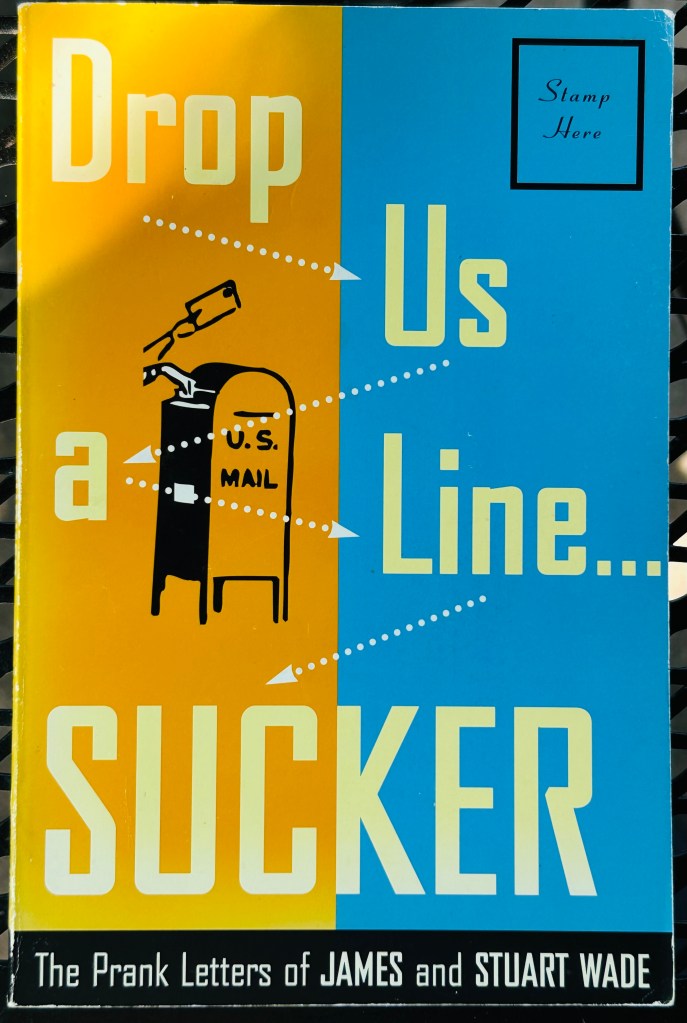
Our premise: Write outlandish but almost-plausible queries to businesses and document their responses. The results:
- We asked Listerine about a fictitious recipe for “Listerine Balls” supposedly sampled at a dinner party; they soberly replied that we “must be mistaken.”
- The makers of Old Spice suggested we consult a physician when we inquired whether their deodorant might prove addictive, claiming multiple daily applications gave us “a clearheaded feeling of invincibility.”
- Purina flatly denied rumors of a new “Squirrel Blend” dog food, and when we asked Hertz to check their lost-and-found for a customer’s elderly mother left in a rental car, they responded without a hint of irony: “We are not responsible for lost items.”
The replies split into four telling categories that mirror today’s corporate communication styles:
- First came the cold shoulder – those who met absurdity with dismissal. Switzerland’s Cheese Union responded to our request for artificial, non-cheese fondue with a terse three words: “We are not interested.” Cunard Lines never bothered to answer whether a manservant could bring ceremonial hog entrails aboard the QE2.
- The second category relied on generic responses, revealing companies more interested in appearing responsive than actually engaging. When we submitted a “Dewar’s Profile” featuring a misanthrope who cataloged livestock diseases, we received a chipper thank-you note proving only that our original query went unread.
- More intriguing were the earnest helpers – companies that took even our most outrageous requests at face value. A dry cleaner offered to launder a nine-inch-thick whaleskin without hesitation. Learjet Corporation detailed their aircraft’s taxiing speed while pondering our question re which countries might allow jets as street vehicles.
- But our favorites? Those rare companies willing to play along, with style. TWA enrolled our fictional dog in their frequent flyer program. Executive Book Summaries, declining our request for a 15-minute version of Faust, claimed they were busy condensing the Encyclopedia Britannica to eight pages. When asked to find a W-shaped house, a real estate agent suggested that J, O, K or E would be easier to locate. Even traditional institutions could display unexpected wit: when we asked Winchester Cathedral in England about hosting a funeral for an eccentric friend who’d “lived all over the world, therefore I believe we need a large church,” they suggested we “approach His Holiness the Pope to see if the service might be held in Saint Peters.”
We found these responses particularly revealing, because they forced companies out of their carefully maintained “image machinery.” When faced with queries that didn’t compute within their standard frameworks, these institutions chose against sticking rigidly to their practiced corporate persona and instead broke character – with fascinating results.
What’s changed in 30 years? The medium, not the message. Today’s corporate communication flows through tweets, chatbots and customer service AI. The physical letter has evolved from daily ritual to rare treat. In 1995, our project required weeks of patient waiting. Today, that same experiment would play out in real time on social media — trading anticipation for instant gratification.
The digital age promises efficiency but often delivers disconnection. Our book’s best exchanges created unexpected moments of authentic connection. Today’s corporate social media teams achieve similar success only when they set aside the playbook, and let their human side show.
Today as algorithms and automation dominate customer interaction, that space has only grown more complex. Our book’s central question still resonates: Can human authenticity survive in an era of automated efficiency?
The answer might lie in those rare companies that dared to play along with our absurd requests three decades ago. They understood that genuine human response matters, a lesson that hasn’t changed.
Thirty years after dropping those lines to unsuspecting corporations, I’m still helping businesses find their voice in an accelerated world. The tools have evolved, but the goal remains unchanged:
Be willing to cut through the corporate static to truly connect.
Sincerely,
WSW
 Stuart Wade