
 by
by Emotionless clones are replacing humans, one by one
Invasion of the Body Snatchers (1956)
Director: Don Siegel
with Kevin McCarthy, Dana Wynter, Carolyn Jones
Invasion of the Body Snatchers (1978)
Director: Philip Kaufman
with Donald Sutherland, Brooke Adams, Leonard Nimoy, Jeff Goldblum
Body Snatchers (1993)
Director: Abel Ferrara
with Gabrielle Anwar, Meg Tilly, Forest Whitaker
Every era finds its own language for obedience. In the 1950s it was duty and decency, in the 1970s disillusion and mistrust, in the 1990s order and security, and today, virtue itself.
It is useless to resist this tale and its message — conformity and the quiet erasure of ‘feeling’ in everyday life. While people sleep, alien beings are taking over their bodies, assuming their exact likenesses, while gestating in strange-looking pods. These “pod people” possess no emotions; they simply live… replacing you forever.
Four decades ago, when the late Don (“Dirty Harry”) Siegel shot his ominous version of Jack Finney’s original story The Body Snatchers, he had no way of knowing this tale would become a cult classic.
According to an interview Siegel gave Peter Bogdanovich in Who the Devil Made It, the terror of the movie is in its absolute reality. “So many people have no feeling about culture, no pain or sorrow,” Siegel said. The takeover of the pod people is as normal as can be, yet it produces “mass hysteria that turns blood relatives against one another.”
Shot in 19 days for $300,000, Siegel’s version suffered when the studio asked him to add a sappy prologue and epilogue. Subtract those tacked-on moments when small-town doctor Miles (Kevin McCarthy) obtains the help of authorities in a neighboring city, and the movie gets a whole lot darker, closing with a hysterical Miles staggering through traffic, shrieking “You’re next!” Chilling stuff, coming as it did during the era of McCarthyism.
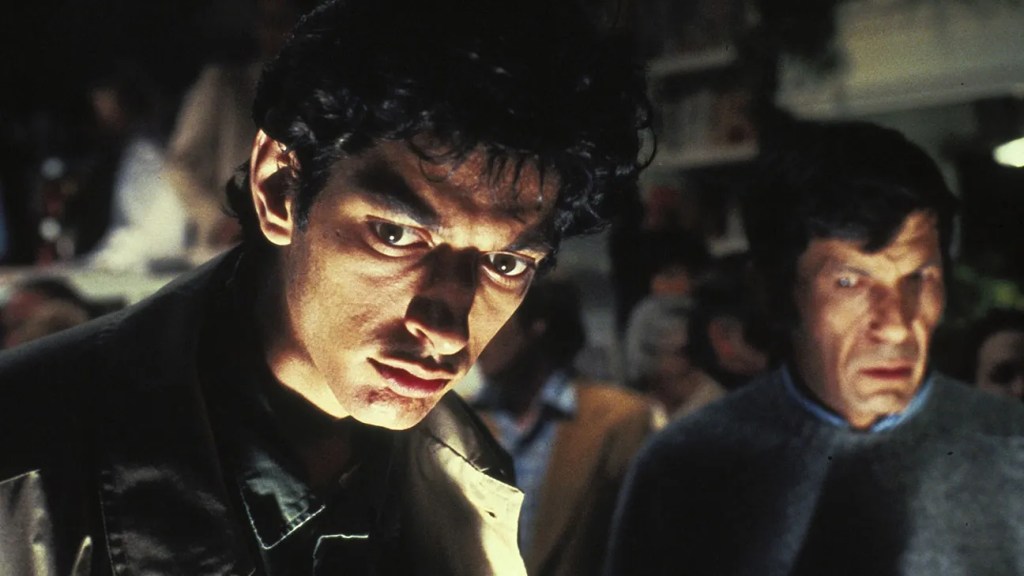
The first update of the story was directed by Phil (“The Right Stuff”) Kaufman. Set in San Francisco, the 1978 film establishes an unsettling atmosphere right from the start, using weird shadows and light, jarring camera angles, and an effective sound trick: a persistent pulse, or throb, underneath the dialogue.

For my money this is the definitive movie version of the Snatchers story.
Donald Sutherland works for the Department of Health, while Brooke Adams is a lab technician who notices her husband has changed. Leonard Nimoy is artfully cast as a celebrity psychologist who is as ice-cold as the logical Mr. Spock.

In a spooky cameo, Kevin McCarthy reprises his panicky-guy-in-the-street role. (Watch the first two “Body Snatchers” back-to-back and you’ll swear the now-graying McCarthy has never stopped running.)
As the bleary-eyed Sutherland and Adams flee, the movie implicates the government, referencing several late-20th-century conspiracies, and adds an omnipresent fleet of garbage trucks that pick up human remains for disposal. Best of all is the story’s conclusion, which ought to jolt viewers wide awake.
When all things conform, there will be no conflict.
This quote is central to director Abel (“The Bad Lieutenant”) Ferrara’s Body Snatchers. A very 1990s update, the story is told from the point of view of a teenage military brat played by Gabrielle Anwar.
Bored, constrained, and forced to look after her much-younger half-brother, Anwar’s character might have the most incentive to go to sleep of any of the Invasion movies’ protagonists.

She’s at odds with her stepmother, played by Meg Tilly. Her father’s transient government job for the EPA contributes even more family tension. Luckily for her, she befriends a hunky JFK Jr. clone (Billy Wirth) who’s also a helicopter pilot.
This version of the pod-people yarn, however, falls short of its predecessors. A foreshadowed conflict never fully develops between Dad and the base commander, the always-intimidating R. Lee Ermey. He doesn’t make skin crawl here quite as convincingly as in Full Metal Jacket. Forest Whitaker, as a military doctor, is all but wasted, appearing in just two scenes.
Although Body Snatchers might not be the preferred among the three versions, it is nevertheless a clever reading of the story. Ferrara’s military setting is a strong idea in that it trades suburban malaise for a drilled-in, army-base brand of obedience.
Through a teenage girl’s eyes, the pod takeover must feel, at least in the beginning, simply like the adult demand to “stop being dramatic” and conform.
As long as “they get you when you sleep,” a bad version of Invasion of the Body Snatchers will never be made. (Check out also Robert Rodriguez’ entertaining 1998 version, “The Faculty,” filmed right here in Austin.)
Each movie reflects the tone of the era it was made for. The Body Snatchers cult fable does not change. It only returns — same story, new shape.
 Stuart Wade