
 by
by November 21, 2021
Book Review. There once was a time when book reviewers roamed the Earth dropping words like ‘elegiac’ on an unsuspecting public. Well, that time has long passed, but hey why not let’s do a review, RIGHT HERE!
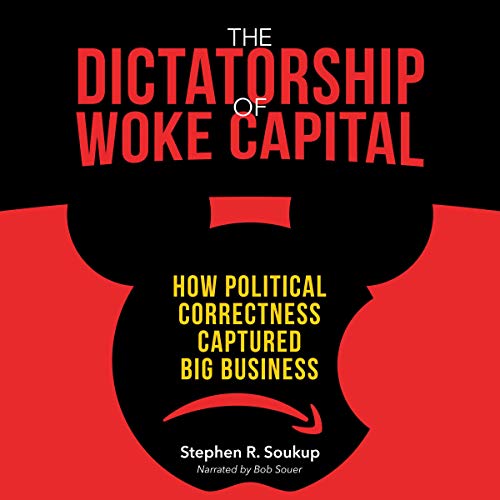
The Dictatorship of Woke Capital: How Political Correctness Captured Big Business by Stephen R Soukup
Soukup is the senior commentator, vice president, and publisher of The Political Forum which serves institutional investment entities.
The Dictatorship of Woke Capital describes how companies that once focused on selling, profit and loss have gradually been coaxed into the arena of politics and advocacy.
Political correctness has captured big business and this book pulls no punches in addressing the consequences. I found the book vital to understanding the coming shift in investment and markets. And as a corporate communicator, I learned a great deal about issues that extend well beyond mere money, and into every corner of society.
The author’s lengthy introduction is powerful (and largely the focus of this review) and he provides history and context during the book’s first half. Soukup is straightforward: the rise of the activist investor, the ‘stakeholder’ having gained priority over the stockholder, and the arrival of *massive* PC hedge funds (Soukup names BlackRock, State Street, and Bridgewater Associates) will dominate the immediate future politicization of capital markets.
While virtuous participants can view themselves as defenders of the oppressed, even as they are earning massive returns, Soukup writes that they paradoxically have bought into deep interests and close ties to the Chinese Communist Party (CCP), one of the worst human rights abusers on the planet.
Founded in 1988, BlackRock, Inc. is the world’s largest asset manager, with $9.46 trillion in assets under management as of 2021.
Nine trillion! Let that sink in a moment.
In 2020 the Federal Reserve chose BlackRock to manage two corporate bond-buying programs in response to the coronavirus pandemic. BlackRock later received approval from the China Securities Regulatory Commission to set up a mutual fund business in the country. This made BlackRock the first global asset manager to get consent from the Chinese government to start operations in the country.
If I understand correctly, the United States government contracted BlackRock as a backup way of making sure it was going to be able to be okay financially when COVID-19 hit. (The agreement coming as it did when it did also ratifies, in a sense, that Sustainability and related matters have officially arrived.)
In addition BlackRock and CEO Larry Fink have positioned themselves as leaders in environmental, social and corporate governance (ESG), areas that characterize sustainable, responsible or ethical investment.
Put simply, ESG scores how companies behave regarding what they invest in. For example, one can no longer invest in tobacco because it is harmful. And that’s a big indicator that we have entered a new corporate era where all companies have “woken up.”
Fink is a true believer in the concept of sustainability. He feels this way because, says the book, over recent years a steady stream of his global corporate clients had been consistently saying the same thing. Specifically that they are “concerned about global warming.”
Utterly fascinating is the author’s statement that it’s not clear — and doesn’t really matter — whether these global entities are truly concerned about global warming as an actual world problem, or whether they just want to make a profit and they acknowledge that in 21st century finance, declaring oneself all-in on climate change is “table stakes.”
CEOs understand that if they don’t acknowledge the idea, then their profits will be affected. Thus all corporations are going to embrace ESG. Sustainability is the new standard for investing.
Among other concepts in this bold book: The average citizen is too uninformed to understand the good that this new way brings him. Someone else must do the work instead. This brings about notions of elites and oligarchies of enlightened corporate and political leaders who make the big decisions and remove unhealthy options — sound familiar? Bad news for those who believe in free markets.
“Depoliticize business. Depoliticize markets. Back to neutral,” Soukup writes. The last thing we in the West should be doing is intertwining big business and policy/politics.
Thus book is an illuminating and rather devastating look at how big business went from being a bastion of the reactionary right to repositioning —re-messaging — itself as leaders on the progressive left. Soukup details how corporate America sold out to woke culture while quietly pocketing billions.
 Stuart Wade