
 by
Still the deadliest battle ever fought on American soil, in July 1863, 8,000 men died here with thousands more succumbing in the weeks after.
J. Rufus Fears taught ancient history at Indiana University in the mid-1980s. His Greece and Rome courses drew some 500 students to the lower bowl of the IU Auditorium. I was among them.
He walked onstage without notes or a text and simply spoke. You were riveted. Fears left Indiana in 1986 for Boston University and later the University of Oklahoma, where he taught until his death in 2012.
Along the way he recorded dozens of lectures on all areas of world history for The Great Courses. One such talk I consumed this year covers the Gettysburg Address, which Lincoln delivered 163 years ago today.
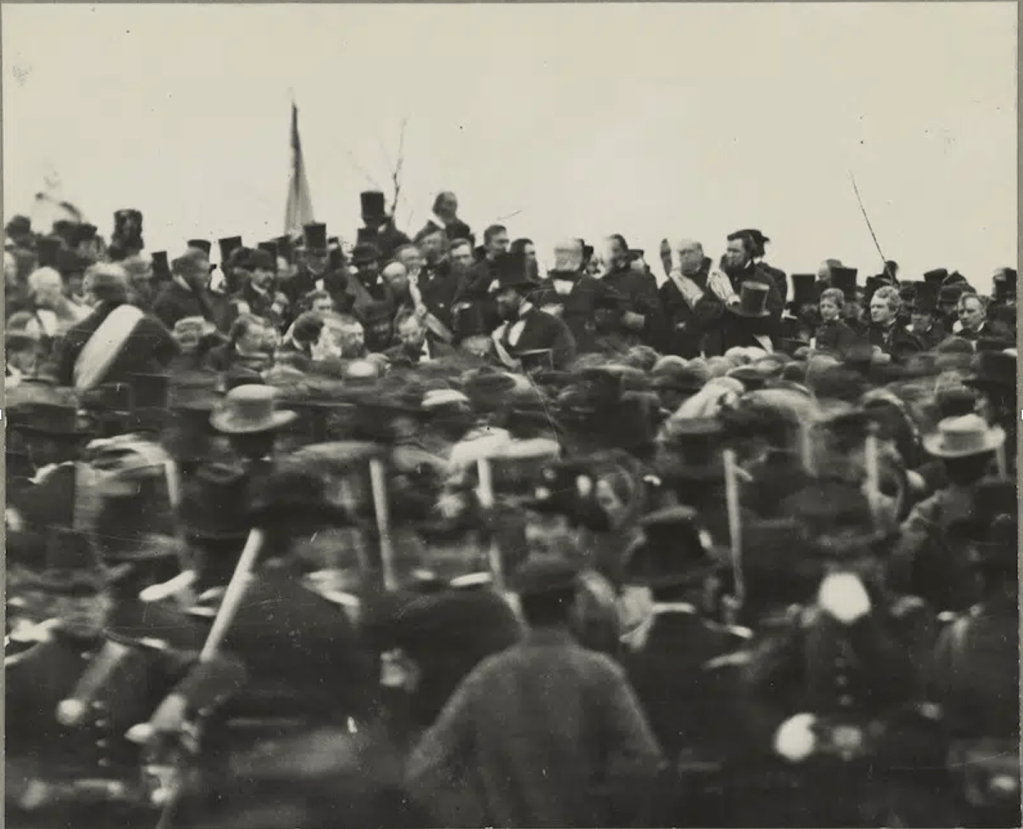
The professor’s lecture opens two months after the battle.
Pennsylvania Governor Andrew Curtin visits Gettysburg soon after, and finds shallow graves scattered across the field, some washed open by rain. With support from other Union states, Pennsylvania helps establish a national cemetery, to be dedicated November 19, 1863.
The organizers choose Edward Everett, the finest orator of the day, as the main speaker. Lincoln receives an invitation almost as an afterthought.
Everett speaks for two hours, then Lincoln rises. Photographer David Bachrach struggles to prepare his camera for a picture of the president. But Lincoln finishes in just two minutes:
Four score and seven years ago our fathers brought forth on this continent, a new nation, conceived in Liberty, and dedicated to the proposition that all men are created equal.
Now we are engaged in a great civil war, testing whether that nation, or any nation so conceived and so dedicated, can long endure. We are met on a great battlefield of that war. We have come to dedicate a portion of that field, as a final resting place for those who here gave their lives that that nation might live. It is altogether fitting and proper that we should do this.
But, in a larger sense, we can not dedicate — we can not consecrate — we can not hallow — this ground. The brave men, living and dead, who struggled here, have consecrated it, far above our poor power to add or detract.
The world will little note, nor long remember what we say here, but it can never forget what they did here.
It is for us the living, rather, to be dedicated here to the unfinished work which they who fought here have thus far so nobly advanced.
It is rather for us to be here dedicated to the great task remaining before us — that from these honored dead we take increased devotion to that cause for which they gave the last full measure of devotion — that we here highly resolve that these dead shall not have died in vain — that this nation, under God, shall have a new birth of freedom — and that government of the people, by the people, for the people, shall not perish from the earth.
Lincoln departed the event believing he had failed the dead he came to honor. The Chicago Times called his words “silly, flat and dishwatery.” In Harrisburg the Patriot & Union hoped “the veil of oblivion” would fall over “the silly remarks of the President.”
Edward Everett disagreed. The next day he wrote to Lincoln, “I should be glad if I could flatter myself that I came as near to the central idea of the occasion, in two hours, as you did in two minutes.”
History sided with Everett.
Fears ranks the address with the Declaration of Independence and the Constitution as one of the three central documents of American freedom. Then he walks through the speech line by line. His reading turns on four ideas.
First is birth. “Four score and seven years ago” echoes the Bible and dates the nation to 1776. Lincoln calls it “a new nation.” Here ‘new’ means something that had never existed before, a nation “conceived in liberty and dedicated to the proposition that all men are created equal.” The image of birth runs through all 272 words. Childbirth is painful, and out of it comes new life.
Secondly, sacrifice. In 1863, families often had no reliable way to learn the fate of a soldier. Some men pinned scraps of paper bearing their names to their uniforms before battle. Many families never got word. A plate stayed set at the table for a son who would never return home. “But they knew why that boy had died,” Fears says. “Lincoln told them.”
By war’s end, somewhere between 620,000 and 750,000 soldiers had died. That is about as many Americans as in all the nation’s other wars combined. (At about 2 percent of the population, today that would mean 7 million.)
“Dedicate, consecrate, hallow. These are religious words. You dedicate a church. You consecrate a shrine.”
The men who “gave their lives that that nation might live” echo the central Christian story of one who died so others might live. Fears hears in it the echo of “The Battle Hymn of the Republic”: As He died to make men holy / Let us die to make men free
And the professor hears Pericles, too. Lincoln had studied the Athenian’s funeral oration in his years of self-education. Like Pericles, he tells the crowd that words cannot honor the dead. The dead have honored us.
Theme number three: obligation. The dead had done their part. “It is for us the living, rather,” Lincoln said, “to be dedicated here to the unfinished work.” Fears put it in four words: “Liberty is a responsibility.”
The fourth and final concept is rebirth. Lincoln resolved “that this nation, under God, shall have a new birth of freedom.” The first birth was flawed. What Lincoln promised in this war-torn moment was, this time the country would get it right.
That last sentence of the Gettysburg Address circles back to the first. A nation conceived in liberty would remain a “government of the people, by the people, for the people” a new birth that shall not perish from the earth.
As I recall from class, Fears seldom spelled out what the past meant for the present. He preferred to tell a story and leave listeners to draw their own conclusions. Forty years later, I still hear him making his case then leaving his students to decide what history demanded of us.
The Civil War set American against American. Neighbors, cousins, sometimes brothers met on the same fields. Five weeks before Appomattox, at his second inaugural, Lincoln said, “Both read the same Bible and pray to the same God, and each invokes His aid against the other.”
In that same inaugural, Lincoln asked the country to act “with malice toward none, with charity for all” and “to bind up the nation’s wounds.” Bitterness lingered for years. Some of it never left.
Yet Lincoln set the country on a path that, Fears states, no other nation torn by so bitter a civil war has managed: back toward one another.
At Gettysburg 163 years ago today, Lincoln predicted that “the world will little note, nor long remember what we say here.” He was wrong. His 272 words are carved in stone at the Lincoln Memorial.
Lincoln spoke to the living. His words resonate.

