
 by
by Latest entry in my Excellent Media Experiences – introduction and complete index here. The most recent prior entry covered the arrival of cable TV.
Nobody misses the screech of a modem handshake, but everyone who heard it during the 1990s regularly remembers that it heralded connection to the world wide web, something genuinely new then.
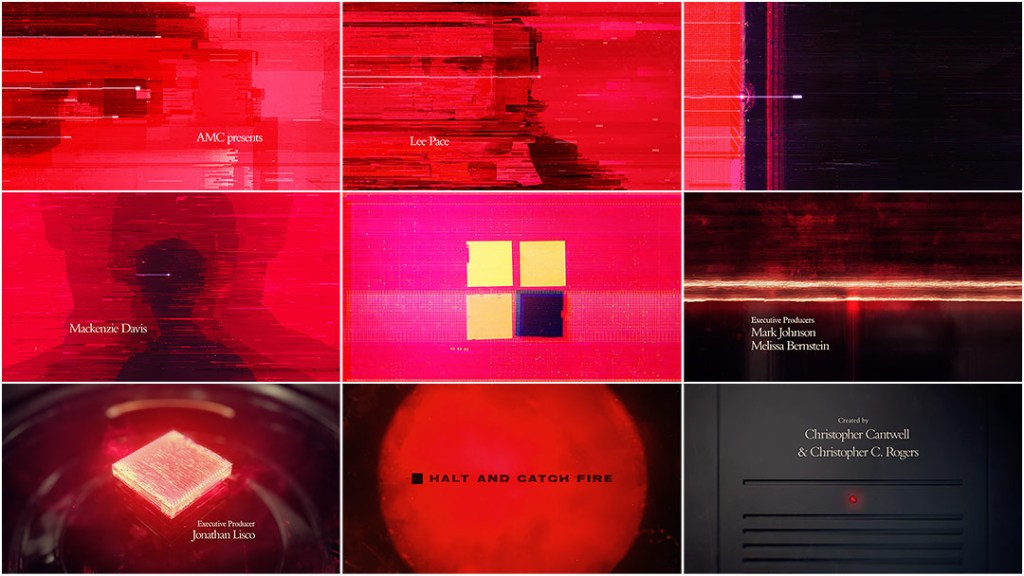
Earlier this month I re-watched Halt and Catch Fire which ran for four seasons on AMC between 2014 and 2017.
Critically acclaimed but lightly viewed, it begins in the Dallas/Austin technology corridor of the early ‘80s. Joe (Lee Pace) is a mercurial sales visionary. Gordon (Scoot McNairy) is a gifted but adrift engineer whom Joe rescues from his own inertia. Cameron (Mackenzie Davis) is a brilliant young programmer who views “normal” as the enemy. The story’s core turns out to be the relationship between Cameron and Donna (Kerry Bishé), the series’ fourth and most complex lead character.
By seasons three and four, when the action migrates to the Bay Area and the subject shifts from computer hardware to online community, Halt is operating at a level that makes you wonder why no one was watching.
The Halt narrative captures that better than anything I’ve watched to date. Two contenders come to mind, yet Halt outpaces both. Mike Judge’s HBO Silicon Valley deserves mention for its wonderful Office Space sendup of Bay Area tech culture. AMC’s current Audacity is bad! It’s unwatchable.
The characters who inhabit this period piece are oddballs, obsessives and misfits — smart people building things that didn’t yet exist. Halt and Catch Fire understood them: arrogant, idealistic, certain of themselves until IPO fever turned their vision into a land grab.
We join the tale in the PC clone wars of the early ‘80s. The series’ production design is precise: beige towers, monitors with their slight curvature and faint greenish cast, the specific patience that dial-up required.
The storyline I found most compelling is the early ’90s, when the show’s fictional Mutiny startup bets everything on online community, evoking CompuServe, the early BBS world and early AOL.
Mutiny is a gaming and chat community struggling with what it’s actually for, eventually drifting toward something like a primitive eBay. The community forums, the user handles, how fiercely people identified with those spaces — the series gets all of it.
The browser storyline is where Halt crystallizes. Cameron and Donna clash over what the web should be, a medium or a marketplace.
When the characters move toward building a search engine, roughly 1996 in the timeline, series creators treat the outcome as unknown, because at the time, it was.
No one at AltaVista, Excite, Lycos or Infoseek, names that won’t mean anything if you weren’t around for the first search engines, assumed they were building a central node of daily life. They thought they were building a better card catalog.
To its credit, Halt doesn’t romanticize this. There’s ample failure and bad decision-making throughout. But it understands that something was lost when builders gave way to monetizers.
Back in 1994, light years ago in the digital world, just getting online took effort: the booting up, then the modem, the wait, often the dropped connection, the resistance built into every session that tech people would come to call “friction.” That resistance kept out the casually interested and rewarded the curious. You had to want to be there.
The social media mopes hadn’t arrived yet to optimize everything for outrage and steal the whole thing, and that loss is Halt’s real subject.
I wanted to be there too, I suppose. My own Excellent Media Experience version of all this was taking shape in Chicago in the early ’90s. We got dial-up first through the Chicago ISP suba, one of the early local operations that predated the national services. And we had CompuServe.
That same year, in 1992, I acquired a one-year-used Pitney Bowes fax machine, a hulking piece of office furniture that occupied a corner of our northside apartment with the authority of an IBM mainframe. I ran a second phone line for it. I had an AT&T pager on my belt.
How very From The Future was I?
This was the infrastructure of my freelance communications practice. It felt like being early money on something. There was a technology optimism to these years that’s hard to reconstruct now but that Halt captures nicely.
It’s the feeling of being young in your career and early to something that matters.
What digital gave me was a side door into feature journalism. The traditional writer’s path into the pages of newspapers and magazines until then required the right J-school degree and a newswriting pedigree before anyone responded.
Email made that irrelevant. You found the editor and sent your pitch directly. The humor book I’d co-written with my brother, Drop Us A Line Sucker!, opened doors at places like McSweeney’s, giving me something tangible to lead with when pitching.
By 1995 I’d moved to Austin, living a distant-cousin version of what the series depicts, known at the time as “the new economy,” rife with new digital careers and a local tech scene deep in the heart of Texas.
Just having an Austin address back then added luster I hadn’t anticipated. The city was its own credential. The music scene, the Dellionaires phenomenon, the fledgling SXSW Interactive conference and the city’s weird-before-weird-was-hip quality all played a part. Editors in NYC found anything from here intriguing and were receptive to you before the follow-up call.
Soon my work was turning up in outlets that wouldn’t have returned my calls a year earlier, including Harper’s, Newsweek International, Spy and The Onion.
Not every chapter from that era went as well. In 1999 I agreed to work for a startup whose stated product was information and publishing but whose true concern was its own stock price. I left after five months.
Watching Halt and Catch Fire again reminds one that the era existed, that its people were having the arguments the series depicts about what the technology was for and who it should serve.
That the series never found a wide audience feels right, honestly. A lot of what mattered most from that era was easy to miss unless you were already looking for it.
The open-web era closed in stages. Super Bowl XXXIV in January 2000 crammed in seventeen dot-com ads at $2.2 million a pop, all of them shouting, “We exist!” to 130 million people who mostly remember the sock puppet. Half those companies didn’t survive the year. Napster showed up around the same time and we started treating copyright theft as a birthright.
Craigslist ate the newspaper classifieds. Y2K descended with apocalyptic fanfare and departed without incident.
SXSW Interactive shed its Omni magazine soul and became an invasion of Bay Area VC clones in black.
WIRED went from techno-utopian scripture to lifestyle brand to advocacy outlet.
The iPhone made work inescapable, and the algorithms finished the job the monetizers started.
 Stuart Wade
1 Comment